Data engineering has quietly become one of the most sought-after disciplines in the tech world. As organizations race to build AI products, modernise their data infrastructure, and comply with tightening data governance requirements, the people who design and operate data pipelines have never been more in demand — or more strategically important. This post looks at what the job market for data engineers looks like in 2026, with a particular focus on the Netherlands, the broader North West European region, and the United States.
A Market Under Pressure — But Still Hiring
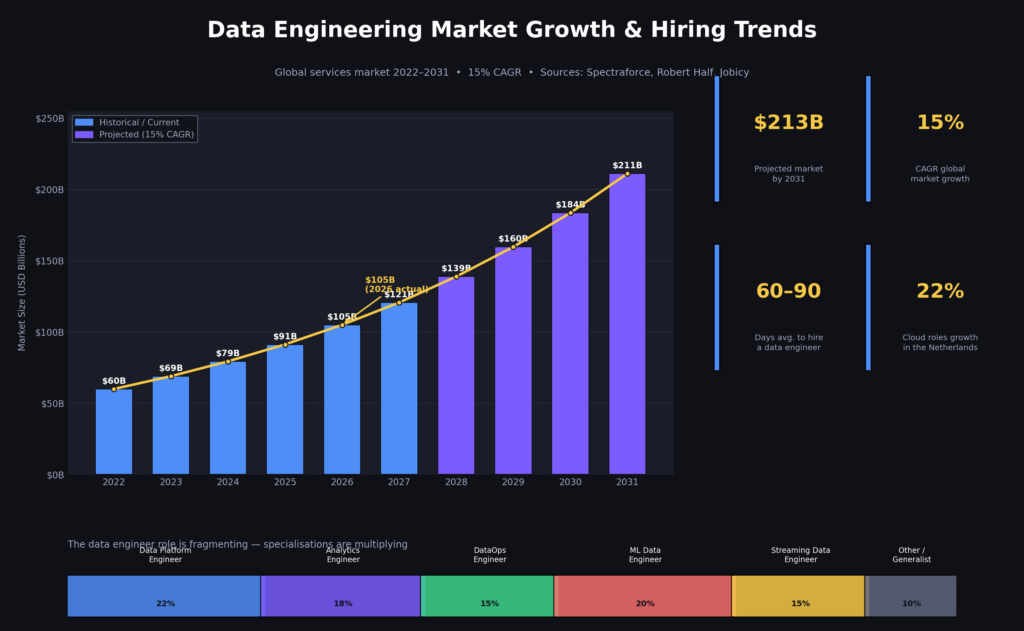
Globally, the data engineering services market is estimated at $105 billion in 2026 and is projected to grow at a compound annual rate of over 15%, reaching $213 billion by 2031. That kind of growth doesn’t happen without people to build and maintain the underlying systems. But “in demand” no longer means “easy to hire for” — or “easy to get hired into”.
According to recruitment specialists like Spectraforce, hiring a data engineer in complex enterprise environments now routinely takes 60 to 90 days, reflecting layered interview processes, architecture reviews, and a candidate profile that is increasingly difficult to find: someone who combines data platform skills, AI integration know-how, cloud expertise, and data governance awareness all at once. The classic data engineer role is fragmenting into specialisations — Data Platform Engineer, Analytics Engineer, DataOps Engineer, ML Data Engineer, Streaming Data Engineer — and employers are raising the bar accordingly.
The Netherlands: A Small Country with Big Ambitions for Data
The Dutch tech market is punching well above its weight. The Netherlands has established itself as a genuine European tech hub — Amsterdam in particular — and data engineering is one of the disciplines driving that reputation. Demand for data engineers in the Netherlands is growing at an estimated 15% annually, with cloud computing roles (a major overlap with data engineering) growing even faster at 22%.
The industries leading the charge are fintech (ING, Adyen, Bunq), logistics and e-commerce (Booking.com, Coolblue), and deep tech (ASML, Philips). These companies are not just hiring to fill seats — they are building sophisticated modern data stacks and need engineers who understand tools like dbt, Snowflake, Apache Spark, Airflow, and Kafka, alongside strong fundamentals in Python and SQL.
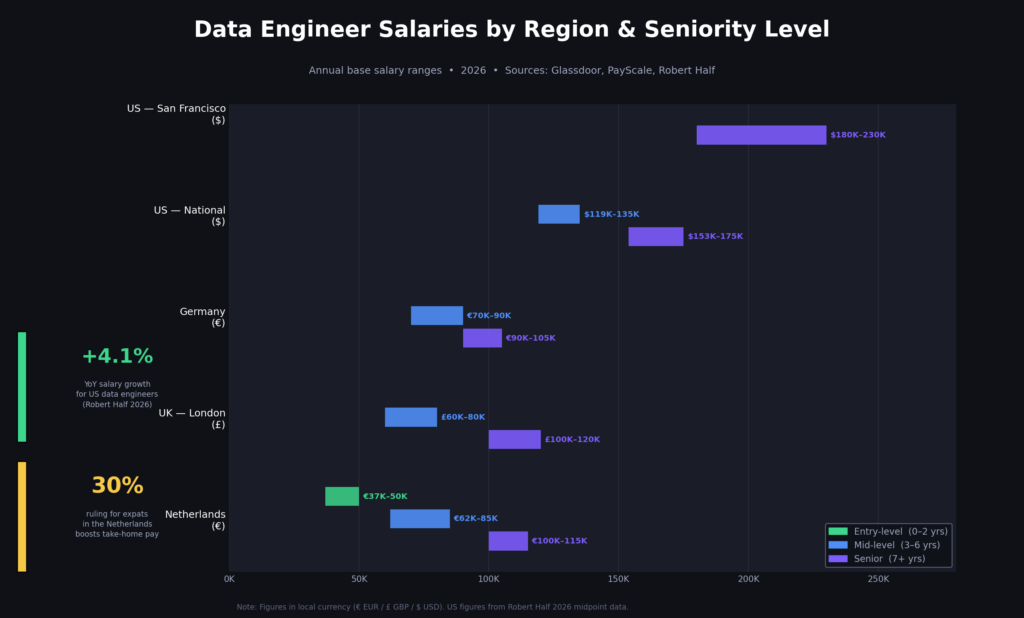
On salaries, the picture in the Netherlands looks like this in 2026. Entry-level data engineers can expect somewhere in the range of €37,000 to €50,000. Mid-level professionals — those with three to six years of experience and hands-on cloud platform skills — typically earn between €62,000 and €85,000. Senior engineers, especially those working in Amsterdam at established tech companies, can command €100,000 to €110,000 or more. The 30% ruling for qualifying expats remains a meaningful factor, effectively increasing take-home pay and helping Dutch employers attract international talent.
Remote work has become increasingly normalised, which is both an opportunity and a challenge for Dutch employers: it widens the talent pool but also means competing with remote-first companies across Europe and beyond.
North West Europe: London, Germany, and the Rise of Secondary Markets
Zoom out to North West Europe and a similar story emerges. The UK — particularly London — remains one of the strongest hiring markets for data engineers in Europe, with typical salaries in the £60,000 to £80,000 range for mid-level roles and senior compensation often exceeding £100,000. Germany, especially Berlin and Munich, is another major cluster, with salaries for experienced data engineers sitting around €70,000 to €90,000.
What’s interesting in 2026 is the rise of secondary markets. Cities like Madrid, Warsaw, and Stockholm are increasingly competitive hiring centres, partly because of lower cost-of-living and partly because remote work has made geography less determinative. For engineers, this creates genuine optionality. For employers in Amsterdam or Hamburg, it means the competition is no longer just local.
Across the region, demand is being driven by the same forces: AI deployment at scale, cloud migration programmes, and regulatory requirements around data quality and governance (the EU AI Act and GDPR continue to shape how organisations structure their data teams). Engineers who understand data governance frameworks, lineage, and compliance are particularly scarce and well-compensated.
The United States: Still the Benchmark for Compensation
The US remains the global reference point for data engineering salaries. According to Robert Half’s 2026 technology salary guide, midpoint compensation for experienced data engineers now sits at around $153,750 nationally, a 4.1% year-on-year increase. In San Francisco and other major tech centres, senior roles can reach $180,000 to $230,000 in base salary, often supplemented by equity.
The US market is large enough to show strong geographic variation. Mid-level engineers in secondary cities might earn $119,000 to $135,000, while top-of-market compensation at major tech firms or AI-first companies is considerably higher. Demand is broad: financial services, healthcare, retail, media, and logistics are all significant hirers, not just the usual Silicon Valley suspects.
The AI impact is particularly visible in the US. Rather than replacing data engineers, generative AI and automation tools are shifting their focus. Repetitive pipeline tasks are increasingly automated, but this frees up — and creates demand for — engineers who can work higher up the stack: designing data architecture for ML workflows, building real-time streaming systems, and ensuring that the data feeding AI models is clean, governed, and trustworthy.
What Skills Actually Get You Hired in 2026
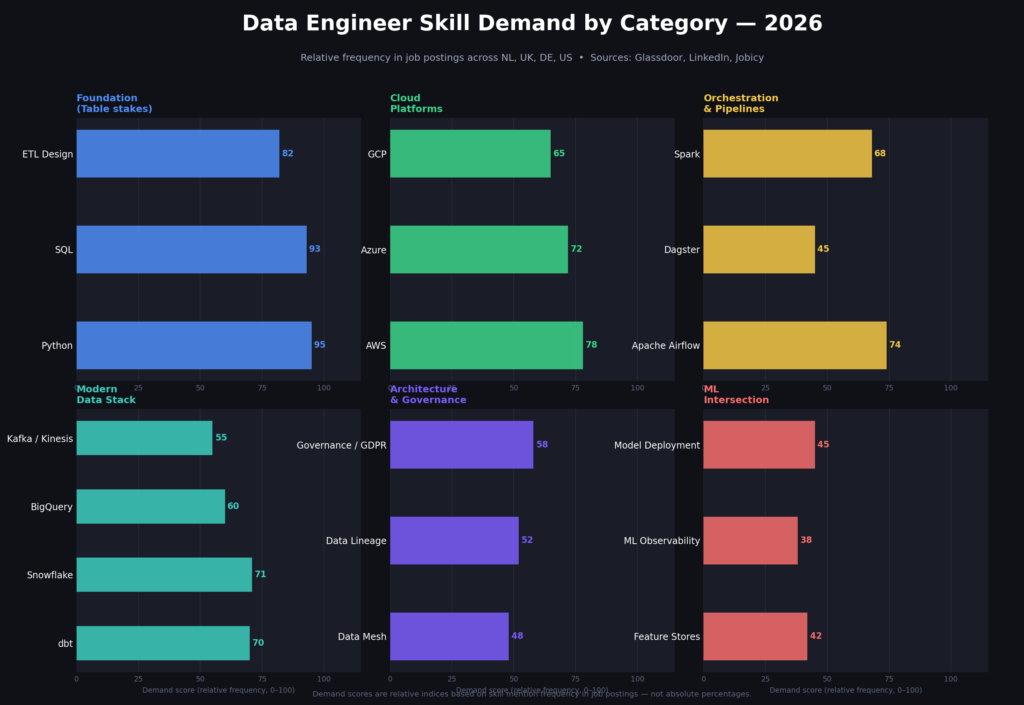
Across all three markets, a clear skills hierarchy is emerging. The foundational layer — Python, SQL, ETL design — is table stakes. Above that, employers are looking for cloud platform depth (AWS, Azure, or GCP), experience with orchestration tools like Airflow or Dagster, and familiarity with the modern data stack (dbt, Snowflake or BigQuery, Kafka or Kinesis for streaming). At the senior end, architectural thinking — understanding data mesh principles, building platforms that other teams can build on, and designing for governance — is what separates good candidates from exceptional ones.
The ability to work at the intersection of data engineering and machine learning is increasingly valuable. Engineers who can not only build pipelines but also understand model deployment, feature stores, and ML observability are among the most in-demand profiles in 2026.
Is It Still a Good Career Move?
Yes, emphatically. Data engineering is one of the few technical disciplines where demand is consistently outrunning supply, salaries continue to grow, and the work is becoming more — not less — interesting as AI raises the stakes for good data infrastructure. The job titles and specialisations are multiplying, which creates more pathways into the field and more room to develop a distinctive niche.
For anyone in the Netherlands or broader North West Europe considering their next move, the outlook is particularly strong. The Dutch market offers competitive European salaries, a concentration of high-quality employers, and a growing ecosystem of data-native companies. Whether you’re early in your career or looking to step up to a senior or staff engineer role, 2026 is a good time to be a data engineer.
Sources: Jobicy, Glassdoor, PayScale, Robert Half 2026 Technology Salary Guide, Spectraforce, DataEngineerAcademy, Index.dev, JobsPikr, ZeroToMastery, Zippia.